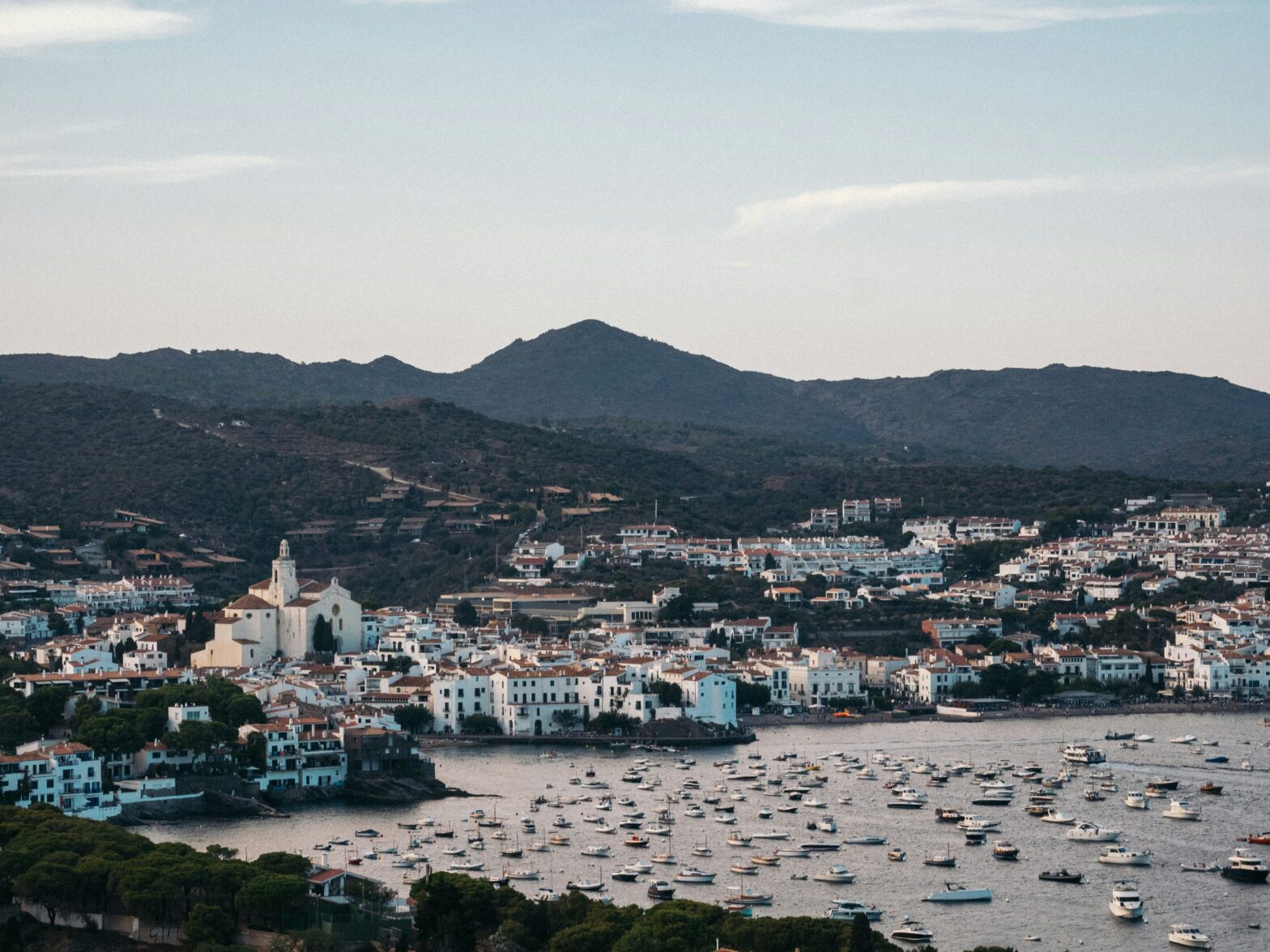
Cadaqués sits on the Costa Brava, on a bay of the same name, in the Alt Empordà comarca of Girona province, Catalonia. It is a town best understood through what it never became: for much of its history it could only be reached by sea, or by a winding mountain road over the Coll de Perafita from Roses. No coastal road was ever built along the shore to connect it more easily to its neighbors, and that stubborn isolation is exactly what is credited with sparing Cadaqués from the large-scale resort development that reshaped so much of this coast.
The result is a historic centre that still runs on steep, narrow, cobblestoned streets lined with whitewashed houses, their style protected today by local building regulations. Cadaqués began as a fishing village, and over the course of the 20th century its economy shifted toward tourism and the arts, a transition that shows in how the town carries both identities at once, working harbour and creative retreat, without either one erasing the other.
Why Cadaqués Became an Artists' Haven
Salvador Dalí spent much of his life just next door, in Portlligat, a small bay immediately beside Cadaqués. He and his wife Gala built their house there from a cluster of former fishermen's huts, and it now stands open to the public as the Casa-Museu Salvador Dalí. Dalí's presence pulled other major figures toward the town throughout the 20th century, among them Pablo Picasso, Marcel Duchamp, Man Ray and Federico García Lorca, and that gravitational pull is a large part of why Cadaqués carries its reputation as an artists' haven to this day.
Beyond Portlligat, Dalí's Castle of Púbol
When in Cadaqués, Dali is everywhere. So of course you have to visit his house in Portlligat, and his museum in Figueres. But don't forget the castle of Púbol. That is possibly the most underrated of Dali-related attractions in the region, I can't recommend a visit to Dali's Castle of Púbol enough. Why? Well maybe it's because I'm a sucker for a love story. In essence, this castle is Dali's love letter, through architecture and design, to his wife Gala.
We visited on a gorgeous autumn day, not sure what to expect in Púbol, but greeted by brown brick buildings, crumbling walls, and this ivy covered castle entry way. At only €6 for students and under 26, and €8 for non-students, a visit to Dali's Castle of Púbol is really a steal. Perhaps this is because Púbol is so remote, but there were no other visitors, and it felt like we had Dali's masterpiece to ourselves for the day.
Entering the museum, you are given a map with the order to visit each part of the castle. Naturally, we completely ignored this and started at the end, Gala's crypt, where she is buried deep in the castle courtyard, her grave surrounded by eery, skinny statues of lions and giraffes. Dali bought the castle in 1968 for Gala and filled it with unusual, delightful pieces set against its medieval exterior, as if it was all one large joke he was playing on the castle's solemn bones.
Probably the most interesting part of our visit was not learning about Dali himself but about his powerful and mysterious wife. Dali designed the castle so Gala could spend her summers there, and there is a contract on display, signed by both of them, stating that Dali could not visit unless Gala gave him explicit permission. It really was her own haven. Upstairs, a small room holds an exhibit of her most elaborate and famous dresses, displayed behind glass, and we each picked out our favourites.
Entry tickets also give free reign of the gardens, including an outdoor garage where Dali's cars are parked, and garden statues made in likeness of his 1948 painting The Elephants. The furthest garden holds a fountain that looks baroque at first and reveals itself as surrealist on closer inspection, ringed with small faces of the composer Wagner, said to have been Dali's favourite.
The easiest way to get there is to drive and park in the free lot in the village of Púbol. You can also take a train to the Flaçà station, four kilometres away, and walk or taxi from there, or take a bus to Flaçà or to La Pera, just two kilometres out. Opening hours and prices vary by season. The address is Gala Dalí Square, E-17120 Púbol-la Pera.
The Church Above the Harbour
The Església de Santa Maria is Cadaqués's parish church, set on raised ground above the harbour so that it looks over the town it serves. Inside, it houses a Baroque altarpiece, a striking counterpoint to the plain whitewashed exteriors that define the streets below.
What the Coastline Actually Offers
Cadaqués does not have long sandy beaches. Its shore is made up of small pebble coves rather than open sand, and understanding that in advance shapes expectations well. Platja Gran is the town's main beach, sitting right in the centre along the harbour, making it the most convenient stretch of shoreline for anyone based in town.
Cap de Creus, Where Spain Runs Out of Land
Cadaqués sits at the foot of the Cap de Creus peninsula, the easternmost point of the Iberian Peninsula, the furthest east any point on mainland Spain reaches. The Cap de Creus Natural Park was established in 1998 and was the first maritime-terrestrial natural park in Catalonia, the first in the region to combine marine and land protection under a single designation. The protected area runs from around Cadaqués out to the Cap de Creus lighthouse at the peninsula's tip.
The terrain here is defined by wind-sculpted rock formations, shaped over time by the tramontana, a strong northerly wind that is a regular and defining feature of the area's weather. It is this wind, as much as the rock itself, that gives Cap de Creus its raw, unrepeatable character, one more piece of a coastline that owes its survival to being just difficult enough to reach.
Photo by Luca Dugaro (@lucadgr) on Unsplash — https://unsplash.com/photos/a_uFoVxON1k


