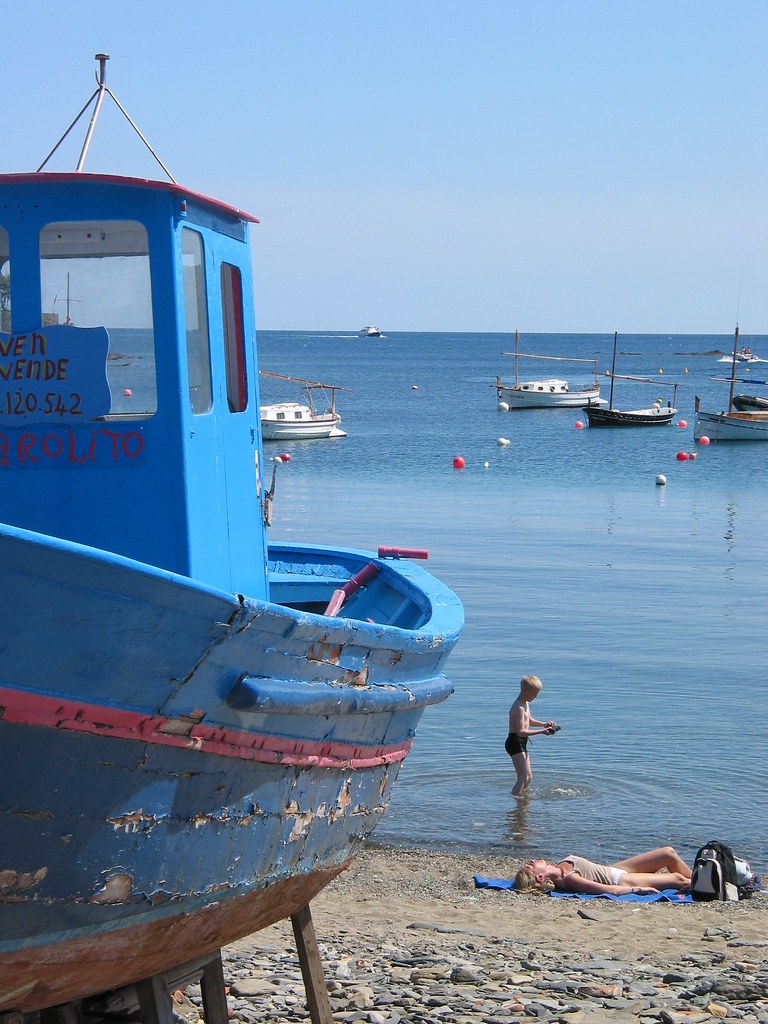
Cadaqués rewards people who choose carefully rather than try to see and eat everything at once. This is a small town, hemmed in by rock and sea, where a good meal and a good walk matter more than a checklist. Here is one way to spend time here, built around what actually distinguishes each place.
Start with the shape of the town itself
The historic centre explains a lot before you've eaten anything. Its streets are steep, narrow, and cobblestoned, lined with whitewashed houses whose style is protected by local building regulations, which is part of why the place still looks like itself rather than a redeveloped version of itself. That preservation isn't accidental. Cadaqués' relative isolation over the centuries is credited with sparing it from large-scale resort development, and it shows in the scale of everything, nothing here is built for volume.
Above the harbour, on raised ground, stands the Església de Santa Maria, the parish church, built between the 17th and 18th centuries. Inside is a Baroque altarpiece, and each summer the church hosts the town's International Music Festival, which gives the building a second life beyond worship. It's worth a look on its own terms and as a landmark for orienting yourself in the tangle of lanes below.
Eat where the reputation is earned, not assumed
Compartir, on Riera Sant Vicenç, is built around shared plates and is consistently one of the best-loved restaurants among diners here, serving a wide range of Mediterranean dishes designed for a table to work through together rather than order individually. It's a good choice if you're eating with people you actually want to linger with.
Talla offers high-quality food that's elegantly presented, and comes with panoramic views over the bay, which makes it worth considering for an occasion rather than a quick bite. If you're after something more relaxed, La Sirena, on c/ Des Call, is a solid choice for Mediterranean rice dishes and seafood, and Celeste, on c/ Nou, serves food with an Italian flavour if you want a change of register mid-trip. For something simpler still, Es Bar de Dalt does sandwiches and tapas, useful if you're mid-walk and just need to refuel rather than sit down properly.
Across the board, seafood here is genuinely fresh, which isn't surprising given the town's fishing origins and its traditional cuisine of dorada, llobarro, anchovies, mussels, and fish with cream. If you want to taste the local wine alongside it, Celler Martín Faixo is worth knowing about: a vineyard set in a building dating to the 1300s, covering sixteen hectares inside the Cap de Creus natural park, producing organic wine harvested by hand.
Trace the Dalí connection properly
Any account of Cadaqués has to reckon with Salvador Dalí, who spent much of his life just around the bay in Portlligat. He and Gala built a house there from a cluster of former fishermen's huts, later expanded into his home and workshop, and he lived and worked in it until Gala's death in 1982. It's now open to the public as the Casa-Museu Salvador Dalí, one of the most-visited museums in the area, opened in 1997. Dalí's presence didn't just anchor his own legend, it drew other artists and intellectuals to the town throughout the 20th century, including Pablo Picasso, Marcel Duchamp, Man Ray, and Federico García Lorca, cementing Cadaqués's reputation as an artists' haven. Around sixty artists still live and work here, and numerous galleries continue to promote local and international work, Galeria Cadaqués among them, notably for including a section specifically for dogs in its exhibitions. If you want atmosphere rather than an exhibit, Bar Melitón was where Marcel Duchamp liked to play chess, and photos of Dalí and Gala can still be seen in L'Hostal.
DALI'S CASTLE OF PÚBOL
When in Cadaqués Dali is everywhere. So of course you have to visit his house in Portligat, and his museum in Figueres. But don't forget the castle of Púbol. That is possibly the most underrated of Dali-related attractions in the region, I can't recommend a visit to Dali's Castle of Púbol enough. Why? Well maybe it's because I'm a sucker for a love story. In essence, this castle is Dali's love letter (through architecture and design) to his wife Gala.
And what a love letter it is!
We visited on a gorgeous autumn day, not sure what to expect in Púbol, but greeted by brown brick buildings, crumbling walls, and this ivy covered castle entry way. At only €6 for students/under 26 (and €8 for non-students) a visit to Dali's Castle of Púbol is really a steal.
Perhaps this is because Púbol is so remote, but there were no other visitors, and it felt like we had Dali's masterpiece to ourselves for the day. As if he had made it just for us, as if he knew that years after creating his masterpiece it would be enjoyed by those who ventured off the beaten path, for secluded and surreal afternoons.
Entering the museum, you are given a map with the order to visit each part of the castle. Naturally, we completely ignored this and started at the end, Gala's crypt. Dali's Castle of Pubol was the masterpiece he made for his wife Gala, and also where Gala spent her final days. She is actually buried deep in a crypt in the castle courtyard, and you can walk down the cool stone steps to see for yourself. Her grave is surrounded by eery, skinny statues of lions and giraffes, perhaps her surrealist husband's final ode, or Gala's decision herself.
Dali bought the castle in 1968 for his wife Gala, and filled it with the most unusual and delightful pieces, as if it was all one large, elaborate joke he was playing on the castle's solemn exterior. Dali designed it so that she could spend her summers there, and there is actually a contract on display that they signed, saying that Dali cannot visit unless Gala gave him explicit permission. It really was her own haven.
Probably the most interesting part of our visit was learning about Gala herself, mysterious and independent as she seemed. Her dress exhibit, a small room on the top floor displaying some of her most elaborate and famous dresses behind glass, is the one part that felt like a conventional museum visit. Entry also gives you free reign of the gardens, including the outdoor garage where Dali's cars are parked, and garden statues in likeness of his 1948 painting The Elephants. The furthest garden houses a fountain that looks baroque at first and surrealist on closer inspection, with little circles around the fish that are likenesses of Wagner's face, apparently Dali's favourite composer.
The easiest way to get there is to drive and park in the free lot in the village of Pubol. You can also take a train to Flaçà station, four kilometres away, and walk or taxi from there, or take a bus to Flaçà or La Pera, only two kilometres away. Opening hours and prices vary by season.
Walk out into Cap de Creus
The town sits at the foot of the Cap de Creus peninsula, the easternmost point of the Iberian Peninsula, where the Pyrenees finally meet the sea. The park became Catalonia's first natural park to combine marine and land protection in 1998, and its terrain is defined by wind-sculpted rock formations, shaped over time by the tramontana, the strong northerly wind that's a regular feature of the area's weather. Locals have given some of these formations names like The Camel, The Eagle, and The Turtle, which makes an aimless walk considerably more entertaining. The park is good territory for boating and water sports as well as cycling and hiking if you want to get further from town.
At the tip of the peninsula, the Cap de Creus lighthouse, which opened in 1874, can be reached on foot along a six-kilometre trail and houses a small museum on the park's natural environment. It's also where people gather to see the year's first sunrise, if you're the sort who plans a trip around that kind of detail.
Choose based on what you actually want from the day
Put together, a visit here works best as a loop rather than a list: the old town and the church for orientation and history, a proper sit-down meal at Compartir or Talla if you want the evening to matter, a quicker stop at Celeste or Es Bar de Dalt if you don't, the Dalí house in Portlligat for the story that shaped the town's whole artistic identity, and Cap de Creus for the landscape that shaped Dalí. None of it requires rushing. That, more than any single restaurant or view, is the actual case for Cadaqués.
"Port of Cadaques, Catalunya, Spain" by Ronald Douglas Frazier is licensed under CC BY 2.0. To view a copy of this license, visit https://creativecommons.org/licenses/by/2.0/.


